What are you actually choosing between?
When Central Florida homeowners shortlist a paver pool deck, the decision usually lands on two finalists: travertine — a natural limestone quarried in large tiles and pavers — and concrete pavers — manufactured units available in an enormous range of colors, textures, and formats, including lines made specifically for pool surrounds. Both are excellent pool deck materials; we install both. The honest comparison isn't "which is better" but which trade-offs fit your deck, your budget, and your tolerance for maintenance. Here's how they differ where it matters.
Which stays cooler underfoot?
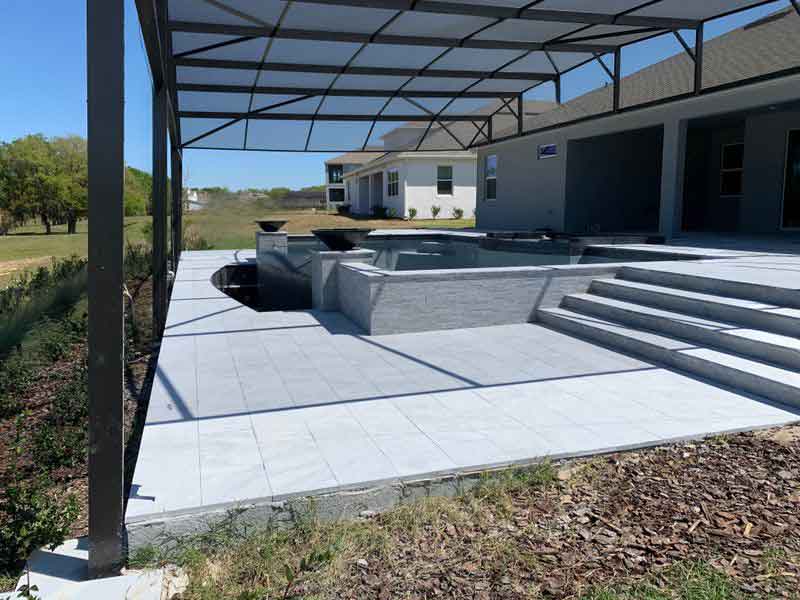
Travertine, usually — and around a Florida pool, this question earns its place at the top. Natural travertine's porous, light-colored surface reflects heat and stays comfortable under bare feet in full summer sun better than most manufactured products. Concrete pavers vary widely: light colors and certain finishes perform respectably, while dense, dark units in open sun can get genuinely hot. If your deck faces west with no shade and barefoot comfort is your priority, that's a real point for travertine — or for the lightest tones in a concrete line. Material samples on your actual deck, in the afternoon, settle this question better than any brochure.
Which is more slip-resistant?
Both, done right. Tumbled travertine's natural texture grips well even wet, which is a big part of its pool-deck reputation. Concrete paver lines made for pool surrounds are textured for the same reason. The slip picture is less about material than about finish (avoid polished or smooth-face products at a pool), drainage that doesn't leave standing water, and keeping algae film off shaded areas — that last one is maintenance, not material (our safe-cleaning guide covers it).
How do they handle salt systems and pool chemistry?
This is the trade-off travertine owners need to hear plainly: travertine is limestone — a calcium-based stone — and it's sensitive to acid and can show wear from salt and chemical splash over time, especially at the waterline and splash zone. It's not a dealbreaker (countless salt-pool decks are travertine), but it makes sealing and periodic care genuinely important rather than optional. Concrete pavers are more chemically forgiving overall, though they also benefit from sealing against chlorinated and salt splash. If your pool runs a salt system and you want the lowest-sensitivity surface, concrete pavers take this category; if you want travertine anyway, budget for a good sealer and a realistic resealing rhythm (sealing 101).
How do looks and design range compare?
Travertine's look is the look: veined, tonal, natural variation that manufactured products imitate but don't equal, in a palette of warm ivories, walnuts, and silvers. If the design brief is "resort," travertine is usually how it's achieved. Concrete pavers counter with range — hundreds of colors, formats from cobble to large-format planks, crisp modern lines, and easy contrast borders and patterns (the pattern guide applies fully to pool decks). Travertine is also a natural product with lot-to-lot variation; concrete is consistent by manufacture. Neither is "nicer" — they're different design languages, and coping choice (the border at the water's edge) can pair with either.
What about durability and repairs?
Both are installed the same way — individual units over a compacted, graded base — so both inherit the paver system's best feature: a stained, chipped, or settled unit can be lifted and replaced without saw cuts or patches. Concrete pavers are hard-wearing and predictable; through-mixed color means minor wear doesn't read the way surface finishes do. Travertine is plenty durable for a lifetime deck but is a softer, porous stone — it can chip at edges under impact and prefers not to meet harsh cleaners or aggressive pressure-washing. Either way, the deck lasts as long as the base under it; that part of the story is identical (the layer stack explained — same system, lighter loads).
Which costs more?
As a general rule, natural travertine runs above standard concrete paver lines installed, with premium concrete collections narrowing the gap — but pool deck pricing swings with deck size, demolition of an existing surface, coping, drainage corrections, and site access, so honest numbers come from a site visit rather than a table. We quote both options side by side on request, and we'll tell you plainly when your project's conditions favor one over the other. Every quote is free.
The bottom line
Choose travertine when barefoot comfort in full sun and the natural-stone look lead your brief — and accept a sealing discipline, especially with a salt pool. Choose concrete pavers when chemical resilience, design range, color consistency, or budget lead. Both, built on a proper base with drainage done right, give you a deck measured in decades. See how we build custom pool decks, or request a free quote and we'll bring samples of both to your deck at the hottest part of the day — the comparison that actually convinces people.