Does the laying pattern actually matter?
Yes — twice. Visually, the pattern sets the character of the surface as much as the paver color does; a herringbone driveway and a running-bond driveway in the identical paver read as two different projects. Structurally, the pattern determines interlock: how well the field transfers load between neighboring units when a tire rolls across it. On a patio, pattern choice is mostly taste. On a driveway, it's an engineering decision first. Pattern and border details are part of the design step on every paver project we build — and many HOAs ask for them on the application drawing.
What is herringbone, and why do driveways love it?
Herringbone lays rectangular pavers in a zigzag — each unit set at 90° or 45° to its neighbors. The result is a field with no long, straight joint lines in either direction of travel, which is exactly what you want under vehicles: braking and turning forces meet an interlocked mesh instead of a seam they can shear along. That's why herringbone (especially 45°) is the standard recommendation for paver driveways, and it's what we most often lay on ours. The 45° version costs a bit more in cutting along the borders; the performance and the look are usually worth it.
What is running bond, and where does it belong?
Running bond is the brick-wall pattern: units laid in rows with each course offset half a unit. It's fast, clean, and minimizes cuts, which makes it economical — and its long sight-lines can visually stretch a narrow space, a genuinely useful trick on walkways and small patios. Its weakness is directional: continuous joint lines run across the field, so under regular vehicle traffic it doesn't interlock as strongly as herringbone. Fine for patios, pool surrounds, and paths; a compromise choice for driveways.
What about basketweave, ashlar, and large-format patterns?
- Basketweave pairs pavers in alternating horizontal and vertical sets — a traditional, cottage-feel pattern that suits brick especially well. Best on foot-traffic surfaces.
- Random ashlar mixes two to four paver sizes in a deliberately irregular layout. It hides small dimensional variation, feels organic, and has become the signature look for patios and pool decks in natural stone and large-format concrete lines.
- Large-format / plank layouts use big rectangles or long planks, often in a simple stacked or offset grid, for a modern, architectural read. Gorgeous on patios; on driveways, unit thickness and pattern need to be specified for vehicle load — this is a place to lean on your installer's judgment rather than a photo.
How do borders and accents fit in?
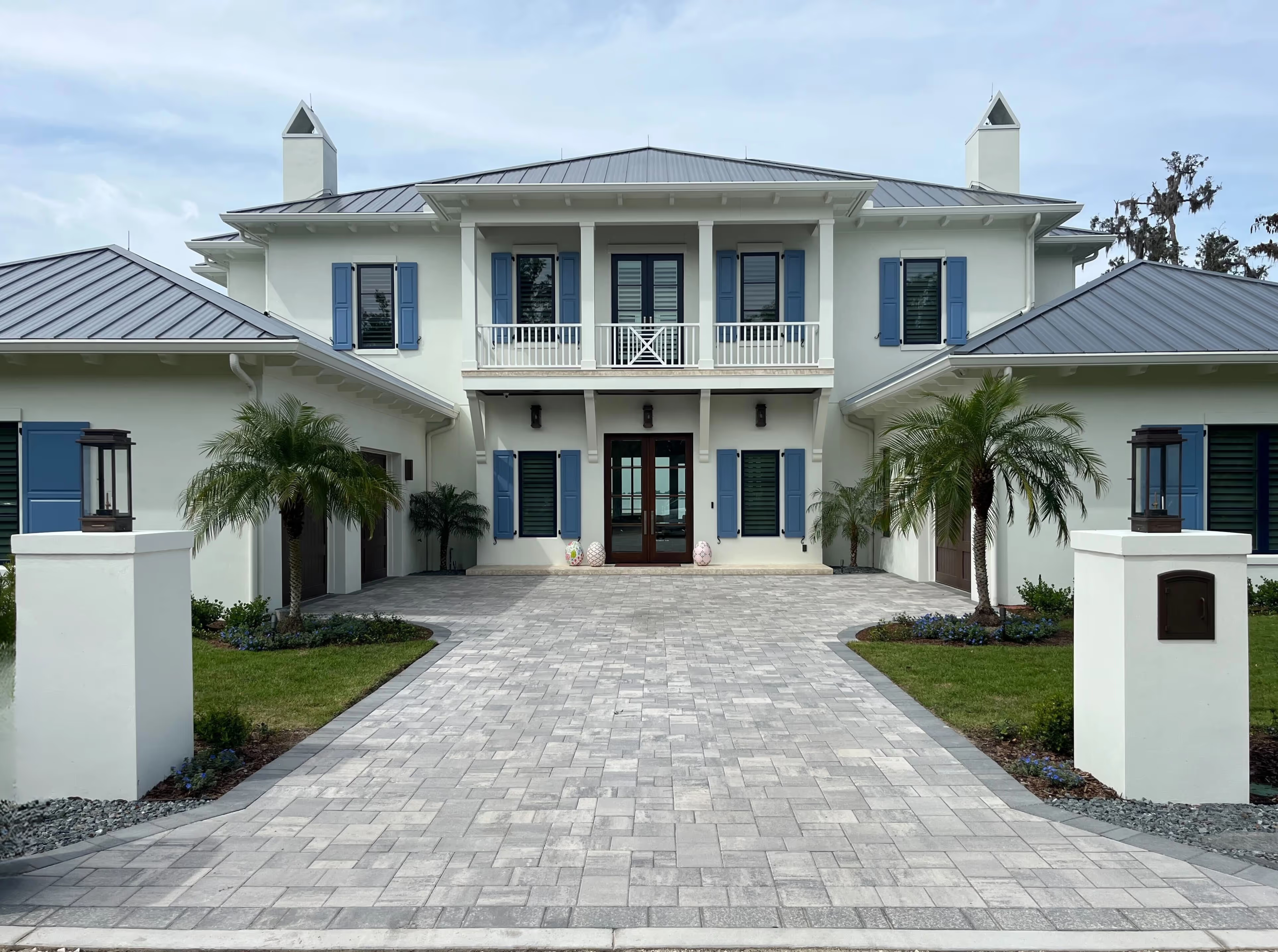
A border course — often a soldier course, units laid side-by-side around the perimeter — does three jobs: it frames the field visually, it gives the pattern a clean line to die into (fewer awkward slivers), and it finishes the edge where the restraint locks the system together. Contrast borders in a darker tone are the simplest, highest-return design move in paving; accent bands and inlays build on the same idea. If you're pairing pattern decisions with material decisions, our travertine vs. concrete comparison shows how far material alone changes the look.
How should you actually choose?
Work through three questions in order. What does the surface carry? Vehicles push you toward herringbone or another high-interlock layout; foot traffic opens the whole catalog. What is the architecture asking for? Formal houses tend to reward orderly patterns (herringbone, basketweave); contemporary builds reward large-format and plank layouts; ranch and Mediterranean styles love ashlar's texture. What's the maintenance picture? Every pattern needs the same care — full joints and periodic sealing — but busier patterns are more forgiving of an individual replaced paver blending in. From there, it's samples on your actual site: colors and patterns read differently in Florida sun than in a showroom.
The bottom line
Pattern is where structure and style meet: herringbone for anything tires touch, the wider catalog for everywhere else, and a border course almost always. If you're starting a project and want to see patterns against real material options, start with the honest surface comparison in pavers vs. poured concrete, then see what we build with them — or request a free quote and bring us your inspiration photos.