
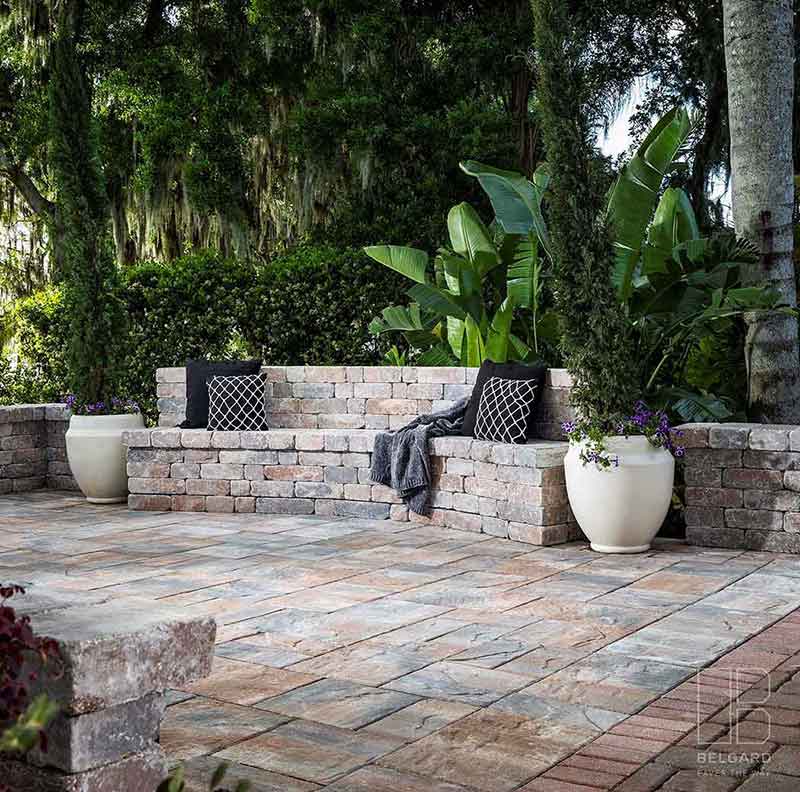
Why do pavers sink?
Pavers sink because the material under them moved. That's the whole story, and it's worth saying plainly: a concrete paver doesn't compress, wear down, or shrink. When you see a dip in a walkway, a rut in a driveway, or a low corner on a patio, the paver is simply following a void that opened underneath it — in the bedding sand, the base, or the soil itself. Fix the surface without fixing what moved, and the dip comes back.
What makes the ground move under a paver surface?
In Central Florida, settlement almost always traces to one of five causes:
- Under-compacted base or subgrade. The most common by far. If the aggregate base — or the sandy soil under it — wasn't compacted in proper passes, it densifies later under traffic and rain, and the surface follows it down. This is a day-one installation defect that shows up in year one or two.
- Water erosion. Concentrated water — a downspout dumping at a corner, runoff channeling along an edge, a grading low spot — physically carries fines and bedding sand away, opening voids. Our drainage guide covers how a properly built system prevents this.
- Empty joints. Joint sand is structural. When it washes out and isn't replenished, pavers rock independently, grinding the bedding layer beneath them into low spots.
- Failed or missing edge restraints. Without a restrained perimeter, the field spreads outward, joints open, and the interlock that distributes load quietly disappears.
- Utility trenches and tree roots. Backfilled trenches settle if they weren't compacted in lifts; roots do the opposite and heave. Both read as "sunken pavers" at the surface.
What does proper base preparation actually involve?
Base prep is the unglamorous half of the craft, and it's where a surface's lifespan is decided. On every project, our installation step runs the same sequence: excavate the existing surface and enough soil to build the full section; compact the subgrade so the native sand is dense before anything sits on it; place crushed aggregate base and compact it in controlled passes — not one token pass over a thick loose lift; grade the base to the drainage plan so water sheds instead of ponding within the system; then screed a thin, uniform bedding course for the pavers. Depth is matched to the load: a driveway that carries vehicles needs a more robust section than a garden path, which is part of what a site visit is for.
How can you tell if a contractor will do this right?
Ask about the part you'll never see. Any bidder can show you paver samples; the differentiating questions are: How deep do you excavate for my soil and my use? What base material do you use, and how do you compact it — in how many lifts? How do you handle the grade, and where will my water go? What edge restraint do you install? A contractor who answers specifically and puts a workmanship warranty behind it is betting their own money on the base. One who talks only about the pavers is telling you where their attention goes. We wrote a full checklist in how to vet a paver contractor.
Can sunken pavers be repaired?
Yes — and repairability is one of the paver system's best features. Because units are individual, a settled area can be lifted, the void diagnosed and the base beneath rebuilt and compacted, and the same pavers relaid flush. Done properly, the repair is invisible; there's no saw-cut patch like a concrete slab repair. The key is fixing the cause: re-leveling over an eroding void is cosmetic, and it won't last. Re-leveling and base correction are core parts of our paver cleaning & repair service.
What maintenance keeps a good surface from sinking later?
Three habits: keep the joints full (replenish sand when rain drops it below level), keep water where the design put it (extend downspouts, watch for new low spots), and deal with small movements early — one rocking paver is a cheap fix, a spreading soft area is not. Our rainy-season guide covers the seasonal rhythm, and the Maintenance Membership handles it on a schedule.
The bottom line
Sunken pavers are almost never a materials failure — they're a preparation failure, or an erosion problem left to run. Whether you're planning a new surface or staring at a dip in an existing one, the answer is under the pavers, not in them. See how we build the base on every installation, or request a free quote and we'll diagnose what's moving under yours.